Albert Einstein (1879–1955) was a renowned theoretical physicist of the 20th century, best known for his special and general theories of relativity. He also made important contributions to statistical mechanics, especially his treatment of Brownian motion, his resolution of the paradox of specific heats, and his connection of fluctuations and dissipation. Despite his reservations about its interpretation, Einstein also made seminal contributions to quantum mechanics and, indirectly, quantum field theory, primarily through his theoretical studies of the photon.
Einstein's writings, including his scientific publications, have been digitized and released on the Internet with English translations by a consortium of the Hebrew University of Jerusalem, Princeton University Press, and the California Institute of Technology, called the Einstein Papers Project.
Einstein's scientific publications are listed below in four tables: journal articles, book chapters, books and authorized translations. Each publication is indexed in the first column by its number in the Schilpp bibliography (Albert Einstein: Philosopher–Scientist, pp. 694–730) and by its article number in Einstein's Collected Papers. Complete references for these two bibliographies may be found below in the Bibliography section. The Schilpp numbers are used for cross-referencing in the Notes (the final column of each table), since they cover a greater time period of Einstein's life at present. The English translations of titles are generally taken from the published volumes of the Collected Papers. For some publications, however, such official translations are not available; unofficial translations are indicated with a § superscript. Collaborative works by Einstein are highlighted in lavender, with the co-authors provided in the final column of the table.
There were also five volumes of Einstein's Collected Papers (volumes 1, 5, 8–10) that are devoted to his correspondence, much of which is concerned with scientific questions, but were never prepared for publication.
Chronology and major themes
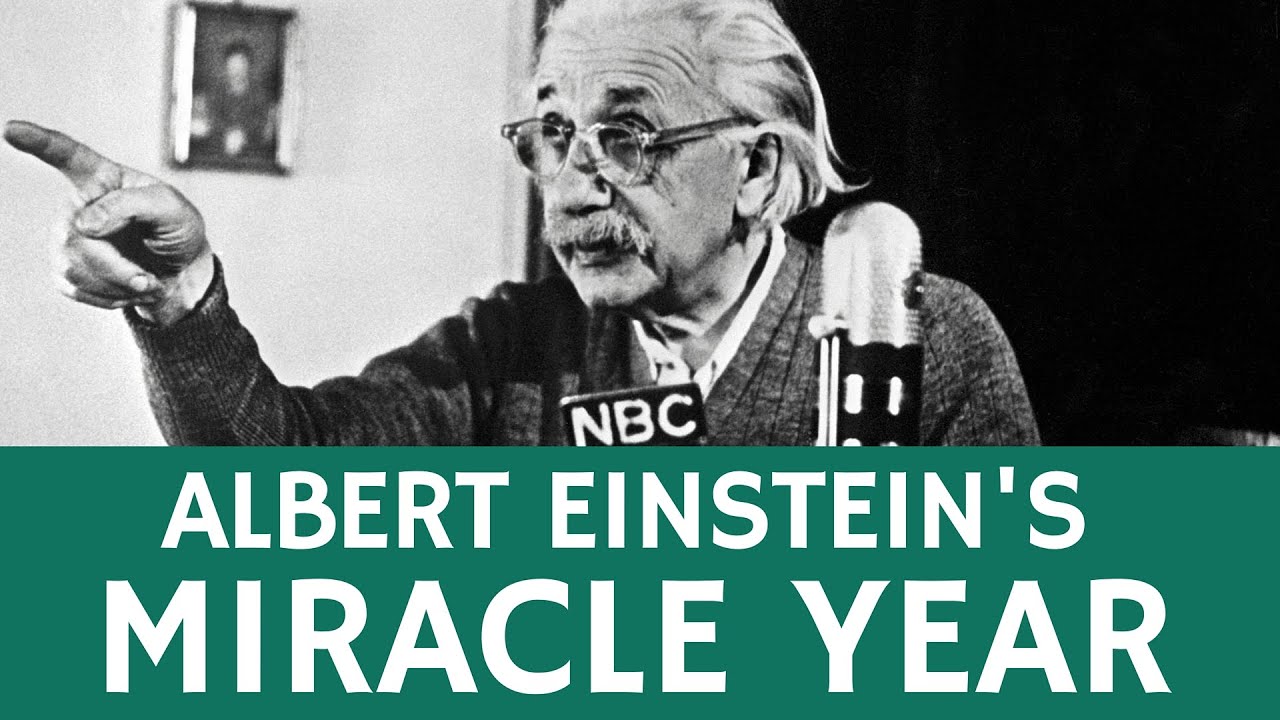
The following chronology of Einstein's scientific discoveries provides a context for the publications listed below, and clarifies the major themes running through his work. Einstein's scientific career can be broadly divided into two periods. During the first period (from 1901 to 1933), Einstein published mainly in German-language journals, notably the Annalen der Physik, and, after becoming a professional physicist, worked at various German-speaking institutions in Europe, including the Prussian Academy of Sciences in Berlin. Following his permanent relocation to the United States in 1933, Einstein spent most of his time at the Institute for Advanced Study in Princeton, New Jersey, where he remained till his death in 1955. During his second period, Einstein submitted his papers in English to North American journals, such as the Physical Review. Einstein first gained fame among physicists for the papers he submitted in 1905, his annus mirabilis or miraculous year in physics. His epochal contributions during this phase of his career stemmed from a single problem, the fluctuations of a delicately suspended mirror inside a radiation cavity. It led him to examine the nature of light, the statistical mechanics of fluctuations, and the electrodynamics of moving bodies.
- From 1901 to 1904, Einstein submitted his first scientific papers, dealing with problems in thermodynamics and statistical mechanics.
- In 1905, Einstein proposed that the existence of light quanta—dubbed photons by chemist Gilbert Lewis in 1926—could explain the photoelectric effect. He treated electromagnetic radiation as a gas and applied thermodynamic reasoning in his "heuristic" treatment, arguing that the energy of a photon is given by Planck's relation, , where is a new constant of nature (the Planck constant), and (nu) is the frequency of the photon. Whereas Max Planck had introduced the quantum hypothesis as merely a mathematical trick to obtain the correct description of blackbody radiation (Planck's law), Einstein considered it to be an aspect of physical reality.: 94–101 In one of his 1905 calculations, Einstein also used, but did not justify or explain, the equation , where is the momentum of the photon and is the speed of light in vacuum. In 1909, Einstein showed that the photon carries momentum as well as energy and that electromagnetic radiation must have both particle-like and wave-like properties if Planck's law of blackbody radiation holds; this was a forerunner of the principle of wave–particle duality. He would go on to receive the 1921 Nobel Prize in Physics for his investigations of light quanta.
- In 1905, to avoid getting into a dispute with his supervisor, Alfred Kleiner, Einstein selected a fairly conventional problem to tackle for his doctoral dissertation, namely, the determination of molecular dimensions using classical hydrodynamics. Such calculations had already been done using gases. But Einstein was the first to successfully solve the problem using liquids. Einstein obtained a respectable estimate for the Avogadro constant, after incorporating better experimental data.: 101–103 Einstein received his doctorate in January 1906 from the University of Zurich. Einstein's doctoral dissertation remains one of his most cited papers ever, with applications in various engineering disciplines, such as concrete mixing and dairy production.: 103 The month following this paper, Einstein submitted a theory of Brownian motion, named after botanist Robert Brown, in terms of fluctuations in the number of molecular collisions with an object, providing further evidence that matter was composed of atoms. He showed that the distance a grain of pollen suspended in a liquid traveled from its starting point was proportional to the square root of the time elapsed and determined Avogadro's number in a new way.: 103–106 A few weeks earlier, he had derived the Einstein relation for diffusion, which was the first example of the general fluctuation–dissipation theorem and gave an estimate of Avogadro's constant. Within months, Einstein's description of Brownian motion was experimentally verified by Henry Siedentopf.: 103–106
- In 1905, Einstein developed his special theory of relativity, which reconciled the Galilean relativity of motion with the observed constancy of the speed of light (a paradox of 19th-century physics). Special relativity is now considered a foundation of modern physics. Its counterintuitive predictions that moving clocks run more slowly, that moving objects are shortened in their direction of motion, and that the order of events is not absolute have been confirmed experimentally. With special relativity, Einstein rendered the notion of the luminiferous ether obsolete.
- In 1905, Einstein concluded that "The mass of a body is a measure of its energy content." In modern form, the equation he wrote down was , where is of an object, is the mass of that object, and is the speed of light in vacuum. He suggested that "bodies whose energy contents is variable to a high degree, e.g. salts of radium" be used to test his new equation.: 137–139 Einstein's mass–energy equivalence was later verified by studying mass defect in atomic nuclei. The energy released in nuclear reactions—which is essential for nuclear power and nuclear weapons—can be estimated from such mass defects.
- In 1907 and again in 1911, Einstein developed the first quantum theory of specific heats of a solid by generalizing Planck's relation. His theory resolved a paradox of 19th-century physics that specific heats were often smaller than could be explained by any classical theory. His work was also the first to show that Planck's relation, , was a fundamental law of physics, and not merely special to blackbody radiation.
- Between 1907 and 1916, Einstein developed the general theory of relativity, a classical field theory of gravitation that provides the cornerstone for modern astrophysics and cosmology. General relativity, which has passed all experimental tests to-date, makes a number of surprising predictions, such as the bending of light by gravity, that matter affects the flow of time, the stretching or redshift of light due to gravity, and frame dragging. While Einstein was highly skeptical that black holes could exist, publishing a paper in 1939 explaining his view, evidence accumulated since the 1960s thanks to advances in observational astronomy, such as radio telescopes, suggests that they do. Furthermore, the principle of the equivalence of inertial and gravitational mass, the foundation of general relativity, has also survived all tests ever devised.
- Between 1914 and 1915, Einstein and Wander Johannes de Haas published a series papers on their experiments showing that a change in the magnetic moment of a free body caused this body to rotate. The Einstein-de Haas effect is a consequence of the conservation of angular momentum and is a demonstration of quantum spin, not yet understood at the time. Einstein and de Haas argued that their results supported the hypothesis by André-Marie Ampère that "molecular currents" were responsible for the field of a magnet, essentially suggesting the existence of the electron.
- In 1916, Einstein predicted the existence of gravitational waves. However, this paper was full of errors and misconceptions. He corrected most of these in another paper published in 1918, but his formula for the energy flux radiated by a slow-moving source was still off by a factor of two. Arthur Stanley Eddington later noticed and corrected the error. Einstein returned to the problem in 1936 with his assistant, Nathan Rosen, arguing that gravitational waves did not exist. An anonymous reviewer commented that they had misunderstood the nature of the coordinates they were using. Einstein and Rosen resolved his issue and reached the opposite conclusion, exhibiting an exact solution to the Einstein field equations, the Einstein–Rosen metric, describing cylindrical gravitational waves. Gravitational waves have been detected by observing the Hulse–Taylor pulsar and directly by the Laser Interferometer Gravitational-wave Observatory (LIGO).
- In 1917, Einstein presented the semi-classical Einstein–Brillouin–Keller method for computing the eigenvalues of a quantum-mechanical system. An improvement of the Bohr–Sommerfeld quantization condition, it allows for the solution of a variety of problems. The Bohr model of the hydrogen atom is a simple example, but the EBK method also gives accurate predictions for more complicated systems, such as the dinuclear cations H2 and HeH2 .
- In 1917, Einstein began the scientific study of cosmology. In order to ensure that his field equations predict a static universe, as was commonly thought at the time, Einstein introduced the cosmological constant (capital lambda). In the early 1930s, upon learning of Edwin Hubble's confirmation of the expansion of the universe, Einstein retracted .: 355–6 The current understanding is that is non-zero. As Steven Weinberg explained, "it was not easy to just drop the cosmological constant, because anything that contributes to the energy density of the vacuum acts just like a cosmological constant."
- In 1918, Einstein developed a general theory of the process by which atoms emit and absorb electromagnetic radiation (the Einstein coefficients), which is the basis of lasers (light amplification by stimulated emission of radiation) and shaped the development of modern quantum electrodynamics, the best-validated physical theory at present.
- In 1924, Einstein read a paper from Satyendra Nath Bose deriving Planck's law using a new statistical method for photons. He developed the idea further into the Bose–Einstein statistics and applied it to ensembles of particles with mass, such as atoms, and predicted the Bose–Einstein condensates, a new state of matter.: 327–329 The Bose–Einstein condensation was first achieved in 1995 by Carl Edwin Wieman and Eric Allin Cornell using rubidium-87. Since then, the Bose–Einstein condensation has also been achieved using other materials, such as liquid helium-4, which becomes a superfluid at temperatures below 2.17 K. Bose and Einstein's papers are seminal contributions to quantum statistical mechanics, which form the basis for superfluidity, superconductivity, and other phenomena.
- In 1935, together with Boris Podolsky and Nathan Rosen, Einstein put forward what is now known as the EPR paradox. Einstein and his colleagues argued that the quantum-mechanical wave function must be an incomplete description of the physical world, and that there could be "hidden variables" not accounted for in standard quantum mechanics. This paper describes the phenomenon of quantum entanglement, a term coined by Erwin Schrödinger in a paper published in the same year in which Schrödinger states his cat paradox. It is Einstein's most controversial paper, and the most important one he published after migrating to the U.S. In 1951, David Bohm reformulated he original thought experiment was reformulated in terms of spin and in 1964, John Stewart Bell proposed experiments to test the inequalities he derived. A variety of experiments conducted since the 1970s with ever improving reliability have demonstrated the reality of quantum entanglement and disproven Einstein's notion of local realism.
- In 1935, Einstein and Rosen proposed the Einstein–Rosen bridge, a hypothetical tunnel connecting different regions of the same universe, in order to resolve the difficulties associated with singularities, such as the ones in the Schwarzschild solution, the central singularity and the one on the surface of the black hole (the event horizon). However, subsequent research demonstrated that the event horizon was a coordinate singularity, not a physical one. (It can be removed by the Eddington–Finkelstein coordinates or the Kruskal–Szekeres coordinates.) Moreover, John Archibald Wheeler and Robert Works Fuller showed in 1962 that this hypothetical structure, also known as a wormhole, was unstable and would collapse before even photons could pass through. Today, the wormhole remains a plot device in science fiction for space and time travel.
- In the final thirty years of his life, Einstein explored whether various classical unified field theories could account for both electromagnetism and gravitation and, possibly, quantum mechanics using increasingly sophisticated mathematics, such as distant parallelism. He was joined by a handful of researchers, notably Hermann Weyl, Theodor Kaluza, and Oskar Klein. However, their efforts were ultimately unsuccessful, since those theories did not match experimental results. For example, the Kaluza–Klein theory, which Einstein briefly pursued, predicted the wrong mass for the electron by a factor of about 1018.
Journal articles
Most of Einstein's original scientific work appeared as journal articles. Articles on which Einstein collaborated with other scientists are highlighted in lavender, with the co-authors listed in the "Classification and notes" column. These are the total of 272 scientific articles.
Book chapters
With the exception of publication #288, the following book chapters were written by Einstein; he had no co-authors. Given that most of the chapters are already in English, the English translations are not given their own columns, but are provided in parentheses after the original title; this helps the table to fit within the margins of the page. These are the total of 31.
Books
The following books were written by Einstein. With the exception of publication #278, he had no co-authors. These are the total of 16 books.
Authorized translations
The following translations of his work were authorized by Einstein.
See also
- Albert Einstein Archives
- Einstein Papers Project
- History of special relativity
- History of general relativity
- History of the Big Bang theory
- History of quantum mechanics
- History of thermodynamics
- Timeline of gravitational physics and relativity
Footnotes
References
Many of the following references are drawn from Abraham Pais' biography of Albert Einstein, Subtle is the Lord; see the Bibliography for a complete reference.
Bibliography
External links
- (in German) List of Scientific Publications of Albert Einstein from 1901–1922 Archived May 8, 2013, at the Wayback Machine from the Einstein website
- Einstein Papers Project at the California Institute of Technology
- Einstein Archives Online at Hebrew University
- Einstein's publications on BibNetWiki